Donation from the Eudists of Quebec to Laval University
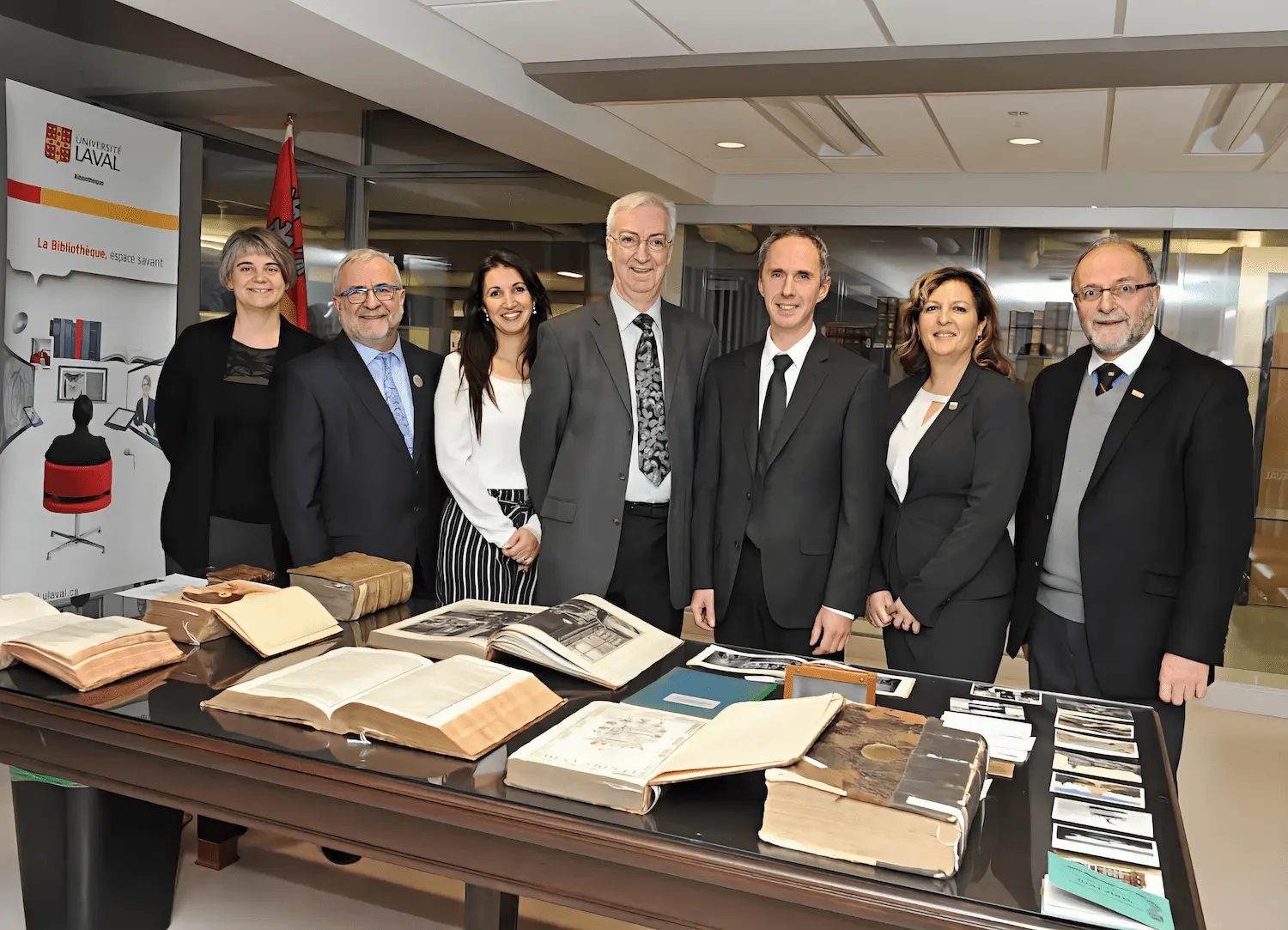
“On November 1, the Laval University Library welcomed the Eudists of Quebec for a recognition ceremony highlighting the exceptional donation made to the University by this religious congregation. This donation, whose value is estimated at $185,000, includes approximately 1,300 old books – the oldest of which dates from 1559 –, approximately 4,000 postcards from Quebec, Canada and Europe and more than 1,400 photographs on glass from the beginning of the 20th century, accompanied by the period viewer.”
(Taken from: le Fil, Volume 52, number | November 2, 2016)
Descriptive catalog of the Eudists library at Laval University
By Mr. Richard Dufour, consulting librarian, Laval University Library
Editor’s note: The Eudists thank Mr. Dufour for the exceptional work carried out which contributes greatly to the conservation of our historical heritage. We reproduce here extracts from Mr. Dufour's document which testifies to his professionalism.
Thanks
Our warmest thanks go to the Les Eudistes Corporation for their generous donation and in particular to their spokesperson in this matter, Father Gilles Ouellet, who was unfailingly kind, welcoming and efficient. He also took photographs of the title pages of the works in the collection, with the help of Robert Berger.
Introduction
In March 2015, Eudist Father Gilles Ouellet contacted Laval University to explore the interest it would have in their collection of old books, postcards, photographs on glass and objects. Following a visit to the Eudist house in Charlesbourg, librarians Richard Dufour and Sonia Léger recommended that the management of the Laval University Library recover almost all of the donated works, and all of the photographs and postcards. From the beginning of April, the Library confirmed its interest and initiated procedures with the Eudists. Several steps had to be taken, both on the Eudist side, for authorizations for transfer by the corporation, and on the Library side, for a proposed donation agreement. The agreement was concluded in March 2016. The documents were boxed by Library employees and the donation was received at Laval University in May 2016. We estimated at the time that the donation represented approximately 1,300 old books, 4,000 postcards from Quebec, Canada and Europe, and more than 1,400 photographs on glass. The book collection actually amounts to 1647 documents.
Historical overview
The founder of the Congregation of Jesus and Mary (Eudists), Saint Jean Eudes, was born in Ri in Normandy in 1601 and died in Caen in 1680. The congregation was involved in evangelization missions and in the training of the clergy by creating or administering seminaries and colleges. Eudist establishments were found, for example, in Caen, Redon and Rennes. The congregation went through difficult times. Having gone through the Revolution, it was confronted a century later with the Waldeck Rousseau law of March 1901 on associations. The religious orders had to ask the French government for the right to carry out their activities as an association. The government refused outright the requests of religious congregations in order to weaken clerical power and appropriate their property. The Eudists knew how to read the warning signs of the coming disaster and reacted before the official expulsion of the religious communities in July 1903. As Basile Babin reports:
“Let us mention in passing an aspect of the persecution rarely reported in history, and yet the subject recurred constantly in the correspondence of 1902-1903. Faced with the threat of government control of religious property, the Eudists took the precaution of sending to Halifax as much as they could of the contents of the precious libraries of their colleges, notably Redon, Kerlois and Angers, in addition to liturgical ornaments and church linens. At the end of November 1902, 90 well-filled crates crossed the Atlantic at once. A few days later, the general treasurer, Father Roussel, wrote to Father Lecourtois in Halifax: You will have a hundred boxes. Your libraries will be enriched with our remains. What makes some people unhappy makes others happy. The books were shared between the houses of Halifax, Pointe and Caraquet. The collection included old volumes of inestimable value, most dating from the 17th century and even beyond. Caraquet lost its depot in the fire of 1915.”
Basil J. Babin, Between a rock and a hard place: Pierre-Marie Dagnaud, at Pointe de l’Église, Nova Scotia, 1899-1908, Charlesbourg, House of Eudists, 1982, p. 226
Following the closure of Eudist colleges in the Atlantic provinces, mainly the Holy Heart Seminary in Halifax, the collection of old books was consolidated in the Eudist house on 1st Avenue in Charlesbourg, Quebec.
On Eudists in Canada, consult Georges de La Cotardière, The congregation of Jesus and Mary (Eudists) in Canada: Fifty years 1890-1940, Besançon, Imprimerie Jacques et Demontrond, 1946.
The latter in turn having to close, the collection was graciously offered to Laval University in spring 2015.
Description of the Eudist Library
We will carry out a detailed analysis of the Eudist collection. It mainly includes monographs and only three periodical titles. The library was evaluated in January and February 2016 by Jean-Claude Veilleux, bookseller in Quebec. He then established the fair market value at $175,650.
Material preservation
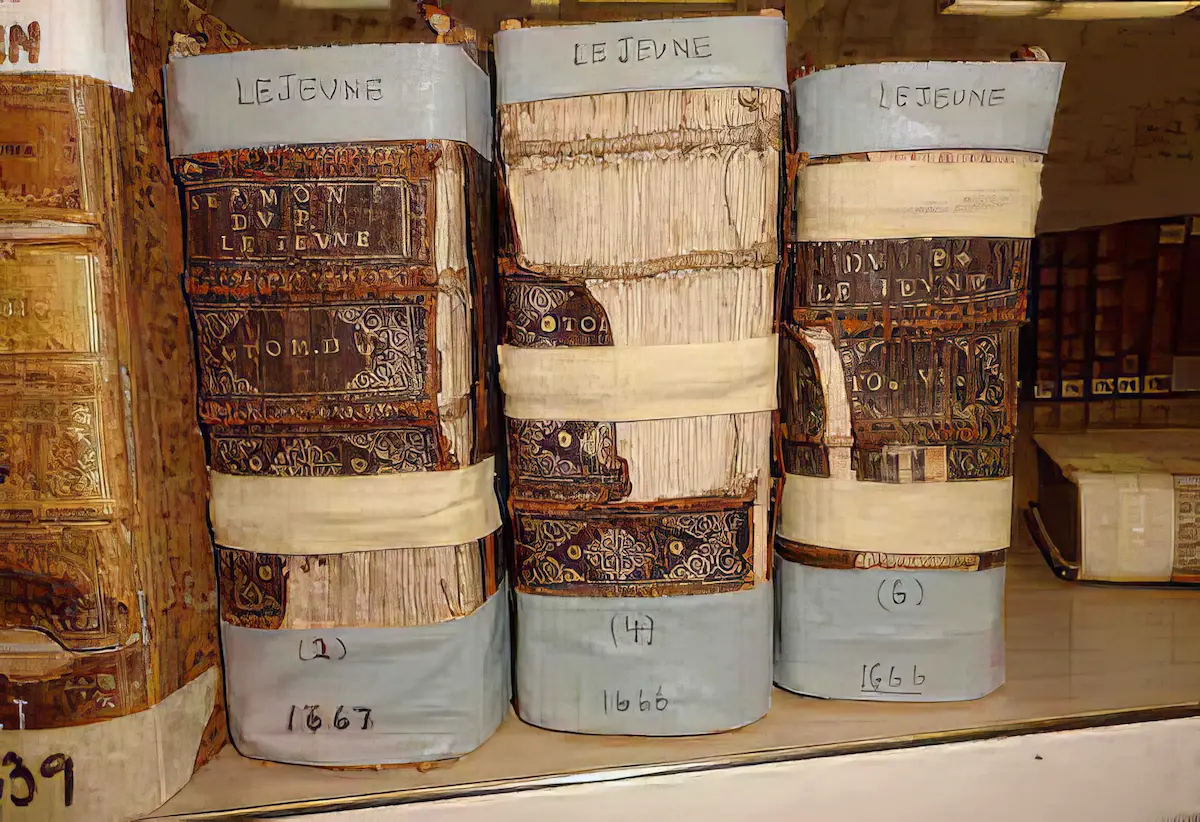
The physical condition of the books varies. The majority are in excellent condition, a minority is damaged, and a few titles are in a condition that makes them more difficult to consult. As part of a library collection, the works have often been the subject of interventions to facilitate their identification. These interventions are unprofessional and distort the volumes. Adhesive tapes of various compositions are affixed to certain volumes: at the top to indicate the author, at the bottom to indicate the year of publication and sometimes the volume number. More damaged books were sometimes solidified by adding adhesive tape. Here are examples that summarize the cases where adhesives have been used:
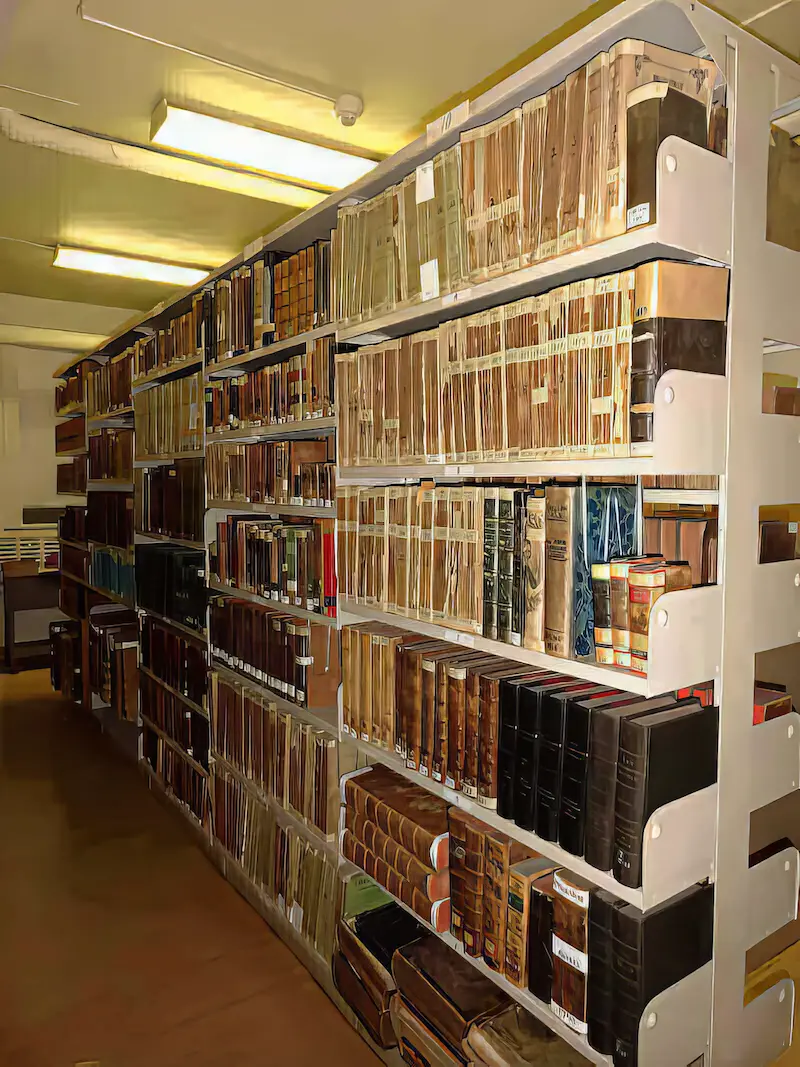
The library received as a donation from the Eudists was located at their house in Charlesbourg. The documents rested on suitable Montel brand shelving, in a basement room. Preservation conditions were good, with cooler temperature and darkness. The books were arranged in chronological order. The large formats were lying on the shelves.
Number of titles
The monograph collection includes 894 titles. If we consider the number of documents, including the multiple volumes that certain titles include, the total rises to 1647 documents. The majority of titles were not already in the collections of the Laval University Library.
Years of publication
A little more than half of the monographs date from the 19th century. Very few documents are from the 16th and 20th centuries, firstly due to the scarcity of 16th century volumes, then by the decision to take only a few documents from the 20th century. Volumes from the 19th century which were too damaged or too common, such as Migne's patrology, were not retained. 11 titles have unknown or uncertain dates and were not included in the statistics.
| Centuries | Number of titles | Percentages |
|---|---|---|
| 16th | 4 | 0.45% |
| 17th | 137 | 15.52% |
| 18th | 240 | 27.18% |
| 19th | 477 | 54.02% |
| 20th | 25 | 2.83% |
| Grand total | 883 | 100.00% |
| Centuries | Number of titles | Percentages |
|---|---|---|
| 19th | 477 | 54.02% |
| 18th | 240 | 27.18% |
| 17th | 137 | 15.52% |
| 20th | 25 | 2.83% |
| 16th | 4 | 0.45% |
| Grand total | 883 | 100.00% |
Publication languages
The library consists of a majority of books in French. Latin also stands out, with other languages having no significant presence except English. French and Latin represent 89.26% of the collection.
| LANGUAGES | Number of titles | Percentages |
|---|---|---|
| French | 564 | 63.09% |
| Latin | 234 | 26.17% |
| English | 80 | 8.95% |
| Italian | 5 | 0.56% |
| Greek | 3 | 0.34% |
| Latin, English | 2 | 0.22% |
| Latin, Greek | 2 | 0.22% |
| German | 2 | 0.22% |
| Latin, Hebrew | 1 | 0.11% |
| Hebrew | 1 | 0.11% |
| Grand total | 894 | 100.00% |
The distribution of languages varies over the centuries. Latin dominates for documents from the 16th and 17th centuries. French clearly exceeded Latin in the 18th century: even if the collection almost doubled in total, the presence of Latin decreased by almost half, while works in French were almost five times more numerous than before. English makes a timid appearance in the volumes of the 18th century and gains strength in the 19th century.
| Centuries | English | French | Latin | Grand total |
|---|---|---|---|---|
| 16th | 4 | 4 | ||
| 17th | 39 | 94 | 133 | |
| 18th | 7 | 188 | 43 | 238 |
| 19th | 65 | 318 | 86 | 469 |
| 20th | 8 | 13 | 3 | 24 |
| Grand total | 80 | 558 | 230 | 868 |
Places of publication
Most of the collection comes from the Eudists of France, it is not surprising that the library contains an imposing majority of books published in France. The rest of the works are European, with the notable exception of American books, which account for 6% of the collection. The eight countries below represent 98.08% of the Eudist library.
| Places of publication | Number of titles | Percentages |
|---|---|---|
| France | 647 | 73.36% |
| UNITED STATES | 53 | 6.01% |
| Belgium | 52 | 5.90% |
| Italy | 40 | 4.54% |
| England | 28 | 3.17% |
| Scotland | 20 | 2.27% |
| Germany | 16 | 1.81% |
| The Netherlands | 9 | 1.02% |
| Grand total | 820 | 98.08% |
Among the titles published in France, almost half were published in Paris. More than a hundred titles were published in Lyon. The five cities below are equivalent to 65.87% of the places of publication in the Eudists collection.
| Places of publication | Number of titles | Percentages |
|---|---|---|
| Paris | 427 | 48.41% |
| Lyon | 109 | 12.36% |
| Avignon | 21 | 2.38% |
| Besançon | 13 | 1.47% |
| Clermont-Ferrand | 11 | 1.25% |
| Grand total | 581 | 65.87% |
The titles published in the United States come primarily from New York and Philadelphia.
| Places of publication | Number of titles | Percentages |
|---|---|---|
| New York | 27 | 3.06% |
| Philadelphia | 9 | 1.02% |
| Baltimore | 6 | 0.68% |
| Boston | 5 | 0.57% |
| Chicago | 2 | 0.23% |
| Grand total | 49 | 5.56% |
As for Belgium, the works were mainly published in Antwerp and Brussels.
| Places of publication | Number of titles | Percentages |
|---|---|---|
| Antwerp | 26 | 2.95% |
| Brussels | 9 | 1.02% |
| Mechelen | 6 | 0.68% |
| Tournai | 4 | 0.45% |
| Leuven | 3 | 0.34% |
| Grand total | 51 | 5.44% |
Authors
The library has 466 authors, of which the five main authors represent 12.12% of the works. The collection obviously includes documents from the Catholic Church and particularly important saints of the time, including Alphonsus Liguori and Thomas Aquinas. The theologian and biblical scholar Cornelius a Lapide occupies an important place, with his works in various editions. Massillon's sermons also receive special attention.
| Authors | Number of titles | Percentages |
|---|---|---|
| Catholic Church | 40 | 4.80% |
| Liguori, Alfonso Maria de | 18 | 2.16% |
| Thomas Aquinas (saint) | 16 | 1.92% |
| Lapide, Cornelius Cornelii | 15 | 1.80% |
| Massillon, Jean-Baptiste | 12 | 1.44% |
| Grand total | 101 | 12.12% |
Topics
The collection stands out for the importance given to the works of popes, saints and theologians, including Pope Damasus, Pope Gregory I, Thomas Aquinas, Bonaventure, Saint-Augustin, Anselm, John Chrysostom, François de Sales, Fénelon, Louis Thomassin, Suarez, Robert Bellarmine and many others. Many editions of the Bible according to the Vulgate are present, as well as many editions of sermons. The 614 titles below, grouped into the 16 most frequent subjects, represent 68.67% of the library.
| Topics | Number of titles | Percentages |
|---|---|---|
| Works | 92 | 10.29% |
| Bible | 78 | 8.72% |
| Sermons | 73 | 8.17% |
| Meditations | 48 | 5.37% |
| Spirituality | 46 | 5.15% |
| Moral | 36 | 4.03% |
| Liturgy | 34 | 3.80% |
| Jesus Christ | 34 | 3.80% |
| Clergy | 29 | 3.24% |
| Catholic Church | 25 | 2.80% |
| Spiritual life | 24 | 2.68% |
| Law (especially canonical) | 23 | 2.57% |
| Apologetic | 20 | 2.24% |
| Biography | 18 | 2.01% |
| Catechism | 17 | 1.90% |
| Retirements | 17 | 1.90% |
| Grand total | 614 | 68.67% |
Proprietary Marks
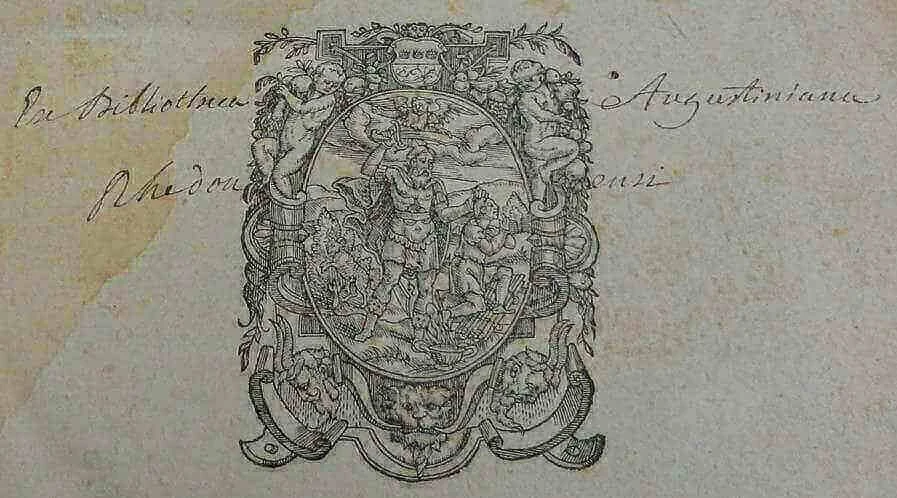
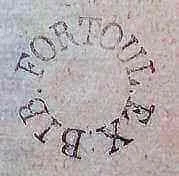
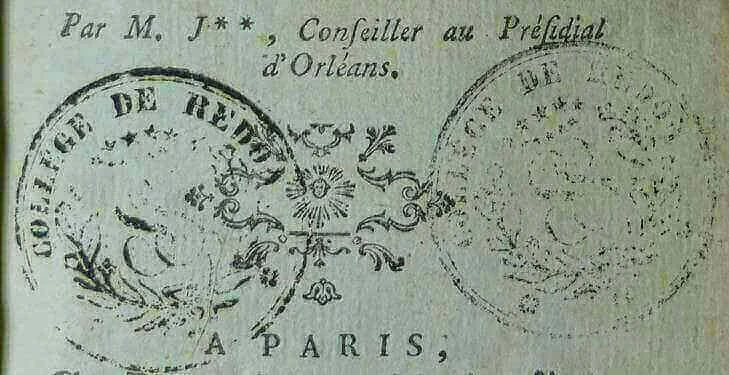
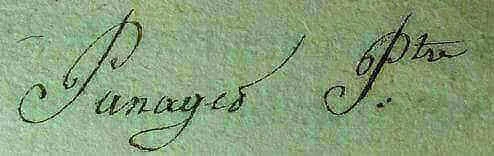
The monographs bear numerous marks of ownership coming from institutions or individuals. These can be stamps, bookplates or signatures. Appendix 1 provides some examples of property marks that appear in the volumes. These marks make it possible to trace the origin of the works and the various owners. The practices of institutions and individuals varied greatly. Some systematically made their mark, others seem to have had no interest in doing so. It is difficult to know the circumstances of the possessions. Several monographs belonged to various institutions and various individuals without us knowing when they were integrated into the collection received from the Eudists.
See François Duine, Memories and observations of Father François Duine, Rennes, Presses Universitaires de Rennes, 2017, chapter “The high school chaplaincy”, paragraph 6, https://books.openedition.org/pur/43144#text.
| Brands | Number of titles | Percentages |
|---|---|---|
| Holy Heart Seminary: Halifax, N.S. | 395 | 44% |
| Panaget, priest | 41 | 5% |
| S.S. Cordis Jesu Seminarium, Charlesbourg | 30 | 3% |
| Holy Heart Seminary, Students’ library | 19 | 2% |
| Congregation of Jesus and Mary, Monastery of the Sacred Heart of Jesus | 15 | 2% |
| Maison St-Martin, Rennes | 13 | 1% |
| Library of the Fathers, Bathurst, N.B. | 12 | 1% |
| Scholasticate Saint-Jean Eudes Library | 12 | 1% |
| Fortoul | 10 | 1% |
| Bibliotheca Augustinianorum Rhedonensium; Bibliotheca minimorum Rhedonensium; Carmelus Rhedonensis; Asceteri Rhedonensis soc. Jesus | 7 | 1% |
| Maison St-Jean Eudes, Laval-des-Rapides, P. Q. | 6 | 1% |
| Redon College | 5 | 1% |
| Grand total | 565 | 63.20% |
Rarity
Volume rarity was approximated by searching titles in WorldCat to estimate the number of copies in libraries around the world. A book is considered rare here if there are fewer than 5 copies in WorldCat. As the reliability of the identification and collection states in this tool is questionable, one must be very careful with this estimate. We did not count works which seemed rare, but which were widely distributed. For example, Thomas Aquinas's Summa Theologica has been so widely distributed in various editions that a specific copy, rare according to WorldCat, is probably not that rare. We have not taken into account the availability of works on the used market.
| Centuries | Number of titles | Percentages |
|---|---|---|
| 16th | 3 | 0.34% |
| 17th | 23 | 2.57% |
| 18th | 29 | 3.24% |
| 19th | 43 | 4.81% |
| Grand total | 98 | 100.00% |
Periodicals
The Eudist library has very few serial publications. The periodicals concerned relate to the First World War. We find volumes 5, 9, 10 and 12 of The great war: the standard history of the all-Europe conflict, published in London by Amalgamated Press in 1914-1918. Even more interesting are the nine volumes bound to form a collection on the Great War. They bring together several issues of The Illustrated London news, published between 1914 and 1919, among which issues of Sphère and Graphic are inserted chronologically. This set specially created by the Eudists is in a magnificent state of conservation and is easy to read with its quality cardboard binding. The binding is sometimes damaged, but the interior is impeccable.
The only religious periodical is the Annales catholiques: weekly religious review of France and the Church, volumes 24 (1878) to 90 (1894), published in Paris by M. Putois-Cretté.
Lists of monograph titles in the Eudist Library
The complete descriptive catalog presents several lists which allow identification according to various criteria.
Consult the collection at Laval University
There you will find the descriptive catalog and files allowing you to download bibliographic records in RIS and Excel.
View the collection ↗
Gilles Ouellet, c.j.m. · October 2016
Presentation of the gift of the Eudists at Laval University of Quebec
Madame Ghaouti, director of the library
Mr. Bernard Garnier, vice-rector for studies
Mr Richard Dufour
Thank you for welcoming us into your home today.
I would like, first of all, to put before your eyes some of the links already created by history between the community of Eudists and Saint François de Laval. Afterwards, we will quickly share with you the reasons for our choice of Laval University for the donation of important pieces from our archives, collected over our 126 years of presence in Canada.
In the seventeenth century, in France, Saint John Eudes, the founder of our community, and Saint François de Laval were not only contemporaries, but acquaintances and friends. After their respective training with the Jesuits, François de Laval found himself in Normandy, in the city of Caen, at the Hermitage of Jean de Bernières, for a period of 4 years before his episcopal ordination. Jean Eudes also regularly visited this house.
They participated, each in their own way, in the great missionary movement of the time which spread from Normandy, and from there to Quebec.
Arriving in Quebec, Mgr de Laval received, from the successor of Jean Eudes, the last posthumous book of our founder, a copy of which was found in the library of the Seminary of Quebec. Also, we found, still in the library of the Séminaire, a rare manuscript by Baron Gaston de Renty, common friend of Jean Eudes and François de Laval, containing a life of Marie des Vallées, a mystic of the time. The Seminary handed over this manuscript to the General Archives of the community in Paris.
Let's skip ahead a few centuries. In 1890, the Eudists came to Canada to found the first French college in Nova Scotia, today, Université Ste-Anne in Baie Ste-Marie. And a few years later, the Halifax Major Seminary, a bilingual seminary open to Eudist candidates and priestly vocations from the Maritime provinces.
Then disaster, in 1903, the Eudists were expelled from France. And a good group, among them, decided to take refuge in our homes in Nova Scotia and New Brunswick; others become missionaries in the villages of the North Shore.
Father Blanche, continuing his travels in search of positions for the Eudist exiles, wrote to the superior general to keep him informed of his transactions and projects. He already suggested not investing all available personnel in the Maritimes, but to think about setting up in the heart of Quebec.
Talks between the Superior General and the Archbishop of Quebec had been underway for several months. Without mentioning the friendship between the future Cardinal Bégin and the T.H. Father Ange LeDoré, Mgr Cyrille-Alfred Marois, vicar general, launched this invitation: Could you not establish, from now on, a house of studies in our city? ... You would send there a dozen or more theologians or philosophers who would follow, for their courses, those of Laval University.
Two of our New Brunswick colleges, a few years later, were affiliated with Laval University. Some of our teachers at the Externat Classique Saint-Jean-Eudes, our college in Limoilou, have become collaborators of the University.
And in the next generation, our scholasticate of theology (Gatineau) was affiliated with the Faculty of Theology of Laval University, allowing our Eudist seminarians to receive the baccalaureate in theology from Laval University.
Finally last year, one of our African colleagues, Father Alain-Patrick David received his doctorate in theology; and a second African colleague, present here today, Father Edem Afoutou, is registered with you for a doctorate in anthropology.
So much for the links with a few generations of Eudists.
Reasons for Donation
In addition to the historical links, we also thought that this deposit of books, which came from France to Halifax at the time of our expulsion, would be well preserved and protected in an institution like yours.
These riches of yesteryear could be made available to a greater number of researchers today in an institution like yours than in a private religious house.
The oldest volumes could be digitized and proposed in inter-university research projects.
At this time, in Paris, the Vincentians, the Sulpicians and the Eudists have chosen to pool their libraries of ancient books and the origins of the Bérullian School of spirituality. Discussions began with the Catholic Institute of Paris for the opening of a research department on this school of spirituality at the origin of this movement of missionary and mystical spirituality which triggered the arrival of all these missionaries, men and women, who worked to build a New France.
Mr. Dean Routhier let me know that the faculty of theology already has some collaboration agreements with the Catholic Institute of Paris. Laval University could also lay an important stone by helping to raise awareness of the main founders who arrived in Quebec, Trois-Rivières or Montreal.
I hope that this heritage from France that we are leaving with you can serve to make a lesser known period of our history better known.
Gilles Ouellet, c.j.m.
October 2016
Appendix 1 · Credit: Richard Dufour
Proprietary Marks
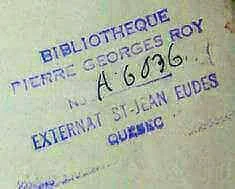


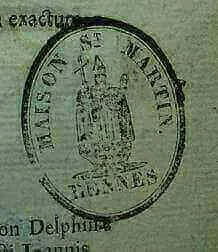
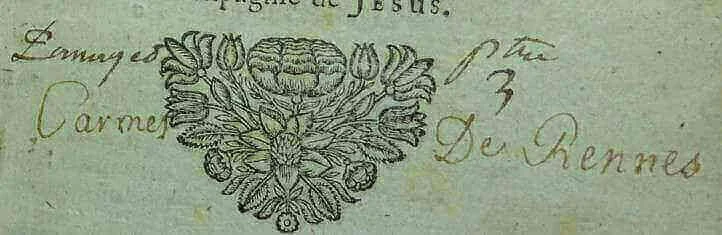
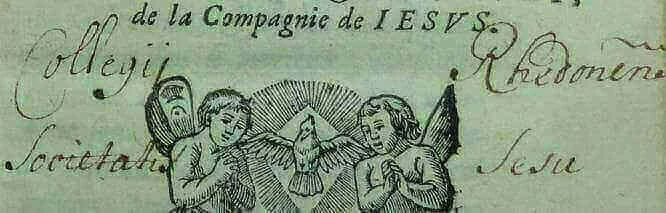

Appendix 2 · Credit: Richard Dufour
Works of particular interest
Bindings, illustrations, annotations and marks of provenance: these documents show the material particularities of the collection. The full description can be found in the original catalog.
File reproduced and adapted from the donation page at Laval University. Catalog and illustrations: Richard Dufour, Laval University Library.